



Shortout Kid
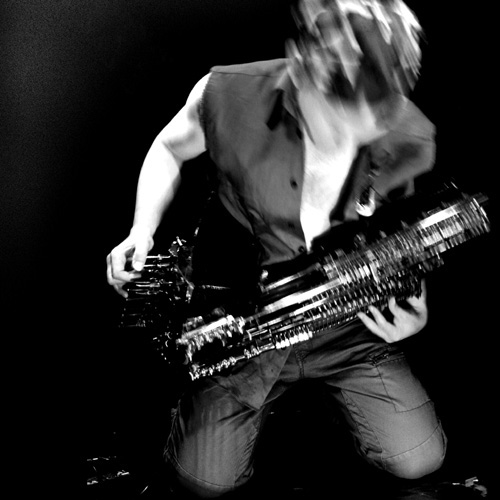
Take Mozart - and teach him to play a chainsaw. Take Kurt Cobain - and have him get addicted to a sampler. Take the softest sound you can get out of an exploding amplifier, and turn it into a ballad. Take Jimi Hendrix, and have him come up with an instrument to play the samples of his laptop.
Shortout Kid is a one of a kind artist. For over 15 years years he worked in seclusion, building an instrument yet unseen by human eye. The looks of it preserve the happy mean between an electric guitar and a chainsaw. It took him another 3 years to get his hands permanently attached to the instrument and to learn to play it virtuously.
He built the instrument to be able to make a kind of rock that is no longer dependent on the sound of a guitar and a drum kit or the iron rigidity of a mixing console. The instrument allows him to play any possible combination of sound waves from his computer, bent or distorted in any possible direction.
Besides being a musician Shortout Kid is the proud holder of the ugliest kind of nofficial World Title in stuttering - and during conversations he regularly makes use of note pads, pieces of paper, pencils and smartphones (sometimes equipped with a bicycle horn) to make himself understood.
Shortout Kid
When Shortout Kid at some point in his teens finds his high school marks dropping as a result of his ferocious attempts to play guitar on the springs of a desk lamp instead of doing homework, he realizes it may be about time to pay a visit to the local music store. Not too long after this visit he masters the art of playing the guitar.
Ever since his childhood Shortout Kid has been a sound freak. He happens to share at least half of his nervous system with a old little toy keyboard lying around the house, which enables him to experiment with chords and sounds - and he regularly drives his parents crazy by continuously alternately pushing the rhythm-buttons, thus creating the best beats ever heard.
People visiting his parents sometimes assume someone is wearing down a typewriter in an unseen room on an unseen upstairs floor of the house - while in fact Shortout Kid is in the process of refreshing the beats of the music on his radio, rattling his hands upon the legs of his arm chair.
The Razor Belt
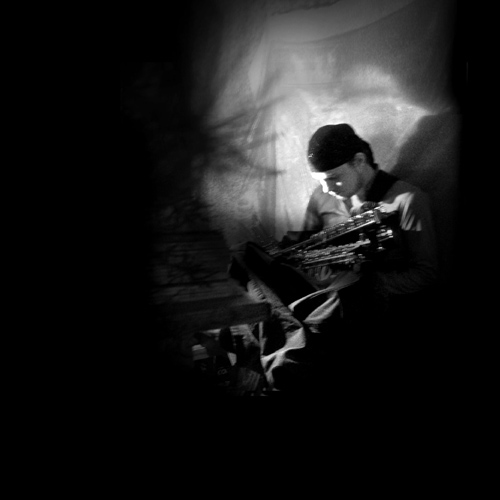
When Shortout Kid finally gets his hands onto a computer that is able to deliver after his liking, the sound output socket is the first searched for and soon first worn out socket on the machine. The local autumn flea market turns out to be an inexhaustible source of amplifiers and speakers, and he nestles in a little shed in the garden of his parents house. He indulges in electronic sound explorations - and he finds ways to turn these sounds into songs.
The keyboard and the guitar by then have begun to fail Shortout Kid. They prove impractical to reproduce the sound-palettes from his computer, and because they also turn out to be of not too much use in manipulating these, he decides to abandon them altogether and build an instrument of his own: the Razor Belt. This instrument, sharing some of its looks with a the combined looks of a chainsaw and an electrical guitar, can be plugged into a laptop or a sampler and allows him to both play and color his sounds and voices.
Numbers

The Razor Belt contains 91 hand-made keys, handles and levers. Each one of these was separately sawn, drilled, filed, joined together, soldered, filed again and polished. They are kept in place by 85 springs, borrowed from 63 ballpoints and mostly for the purpose cut in half. The total number of handmade mechanical parts is 635, nuts, belts and springs not included - consisting out of 1023 pieces. Including wood and electronics it took about 2500 hours to complete the instrument.
Building the Razor Belt takes considerably more time than foreseen. Shortout Kid plans to build the instrument over a two week holiday, but instead it takes him almost 8 years to complete the initial version of the instrument. It is a major disappointment to discover that the inexpensive brass from the building market used for building the instrument contains a percentage of lead, resulting in an instrument weighing over 12 kilograms (about 25 lbs.)
A rebuild of the instrument contains less brass, and weighs about 7 kilograms (about 14 lbs.) This need to rebuild does however create an opportunity to at the same time dramatically improve the accuracy of the key unit, to locally beef up the wiring to household-thickness, to build a support frame underneath the printed circuit board to prevent this from bending and rattling any longer, and to rebuild the fragile handles out of 4,5 inch nails.